I’ve always been interested in design, from graphic to video and board games. Below is a roughly chronological foray into my attempts at creation rather than consumption.
Much of my available free money at uni was spent on editions of Wallpaper* magazine and through my Multimedia Computing BSc degree, I worked in Adobe Illustrator, Photoshop and Macromedia Director to bring early interactive styles to life. Interaction design came through designing UI for pretend CD-Rom applications as coursework.
Sony PlayStation had already launched the year before I started uni and much of the style from The Designers Republic (via “WipEout”) fed into my graphic and interface design. (I am still a massive fan to this day having just taken delivery of the Verdant Brewing x TDR craft beer limited edition.)
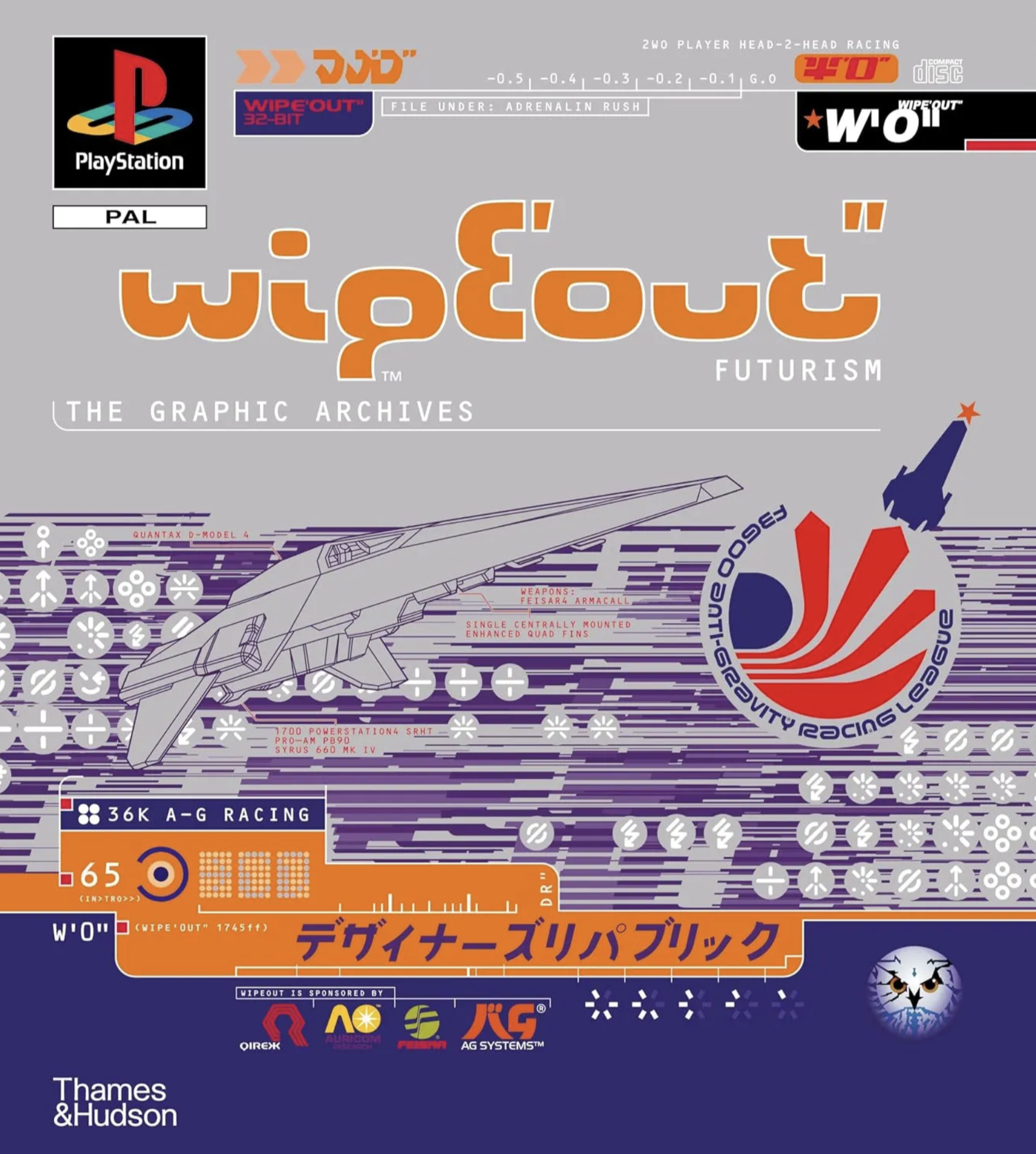
The front cover of the WipEout book
Whilst my skills were good enough to get an OK degree result (a Desmond), they weren’t great compared to others so my employment post-graduation lent on my strengths at the time — attention to detail, technical knowledge and methodical approach to task completion. I went into QA…
I had the knowledge and terminology to clearly report issues with a relevance to the understood intended outcome and speak to designers and developers in a way that didn’t upset them.
It was about a decade later I got the opportunity to be fully and wholly responsible for a game design, albeit a very small, snackable experience, to be brought to life in Macromedia Flash.
“SuperLife”
Working as Technical Producer at Kerb, arguably one of the greatest agencies at the time known for edgy and technologically advanced viral and creative works built in Flash for clients like Sony PlayStation, Channel 4 and many more, a project for a repeat client came along that I was charged with the design of. The BBC (or cBBC) had a long-running YA drama show called “My Almost Famous Family”, which was receiving a digital update with some fresh content to accompany a new series.
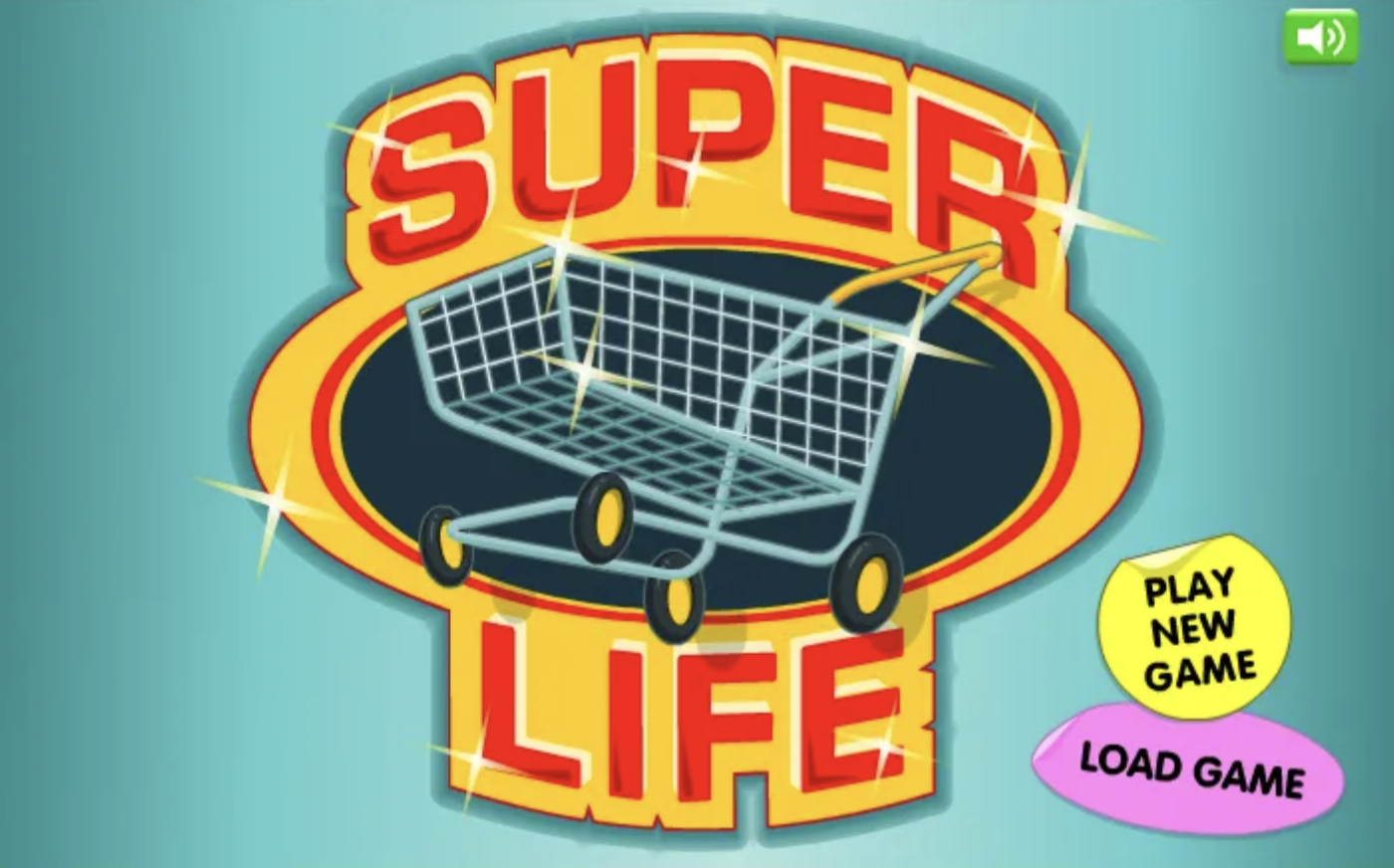
The final title loading screen for Superlife Flash game
In the show aired on screens, the writers had already referred to an online game the family were addicted to, weaving elements of gameplay features and actions into the script, that the actors had already conveyed to the audience watching. This meant I a) had a fairly lengthy set of features, actions and gameplay that was expected to appear in the digital counterpart and b) a lot of material to sift through to find said references.
Once done, carefully balanced against the budget and timescale available, also taking into account the usual review by committee process that occurs when working with the BBC, I had a framework of feasible ideas and some stretch goals up my sleeve.
The game was to be a sim, with the player taking on the role of supermarket assistant manager, juggling employee workloads, energy levels and wellbeing against demanding customers, stock depletion and refilling and occasional urgent events, like a clean up on aisle 3 or a shoplifter to contend with.
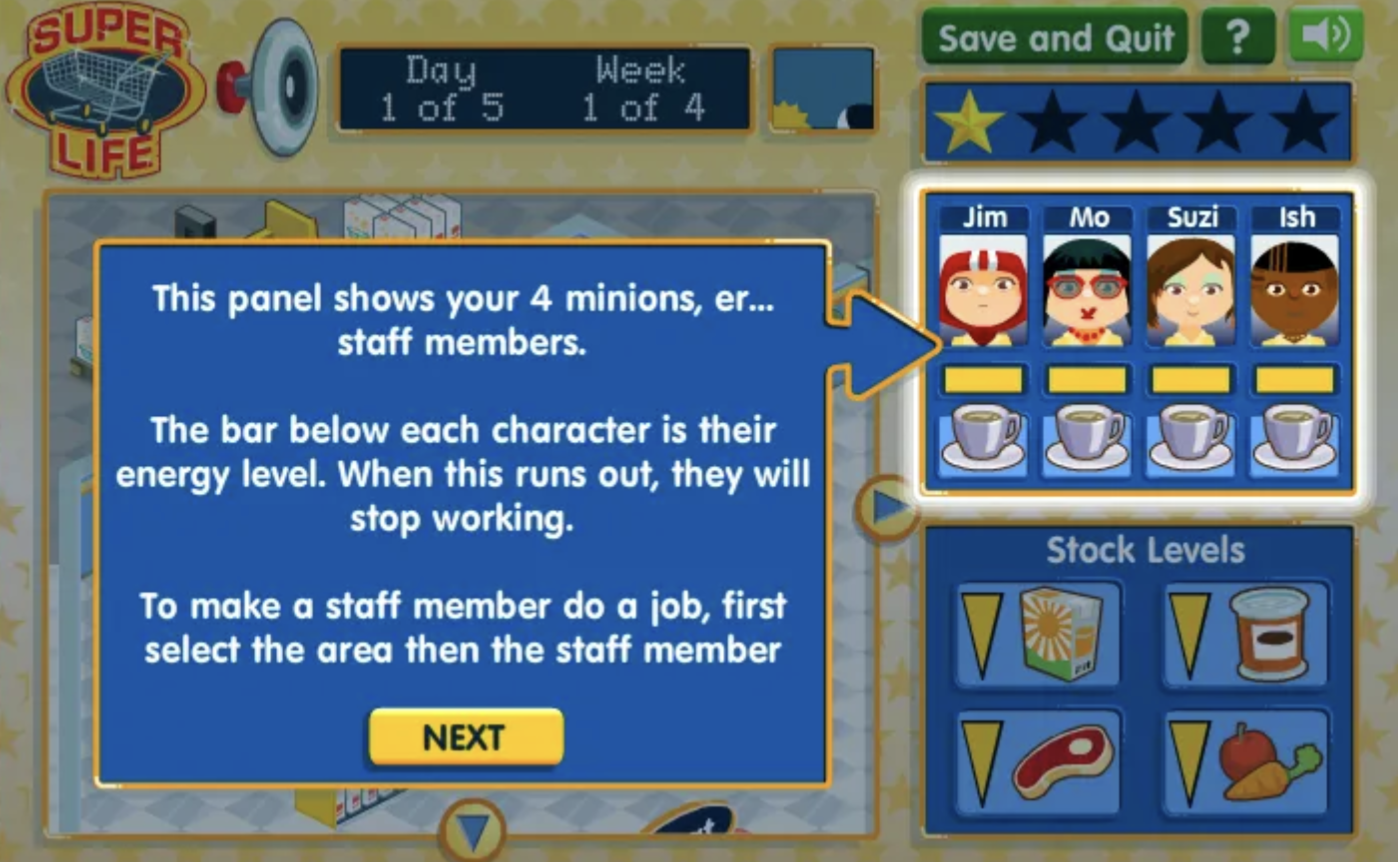
Mock-up of the final tutorial screen
Every action took energy and time, of which both were finite against the clock (store opening times) and at the end of each day, players were scored across stock vs customers served vs staff wellbeing vs events dealt with, or not. This was represented as a star, with the idea being by the end of the (5 day) working week you had x/5 stars and earned a promotion, or not.
The usual Kerb superstars got to work for art and code against the tight deadline and the Flash builds were tested, sent for alpha/beta/final review, with appropriate feedback incorporated (or pushed back on) and it went live on the cBBC website as part of a suite of games promoting the show.
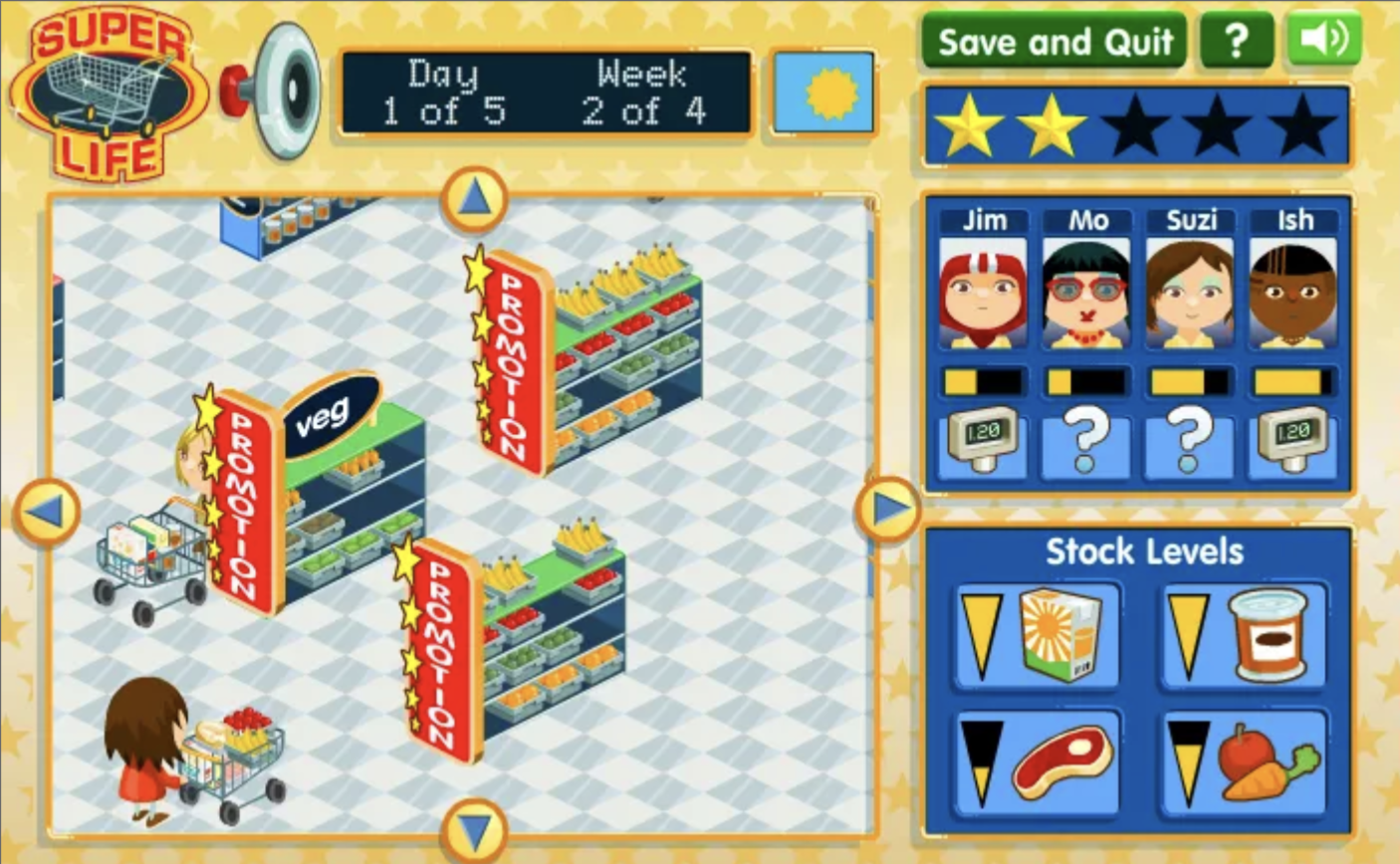
Mock-up of the final game screen showing the active area, information UI and interactive elements
Unofficially my contacts at the BBC told me that the game was one of the most popular games ever on the website and remained the most played game for three months. I’ll take it.
“Radial-G”
A few years later, I found myself holding an Oculus Rift DK1 VR HMD in my hands and the studio I was now working at, Make Real ne Makemedia at that time, were looking for ways to make something for it, with some funding provided by a client of the web dev side.
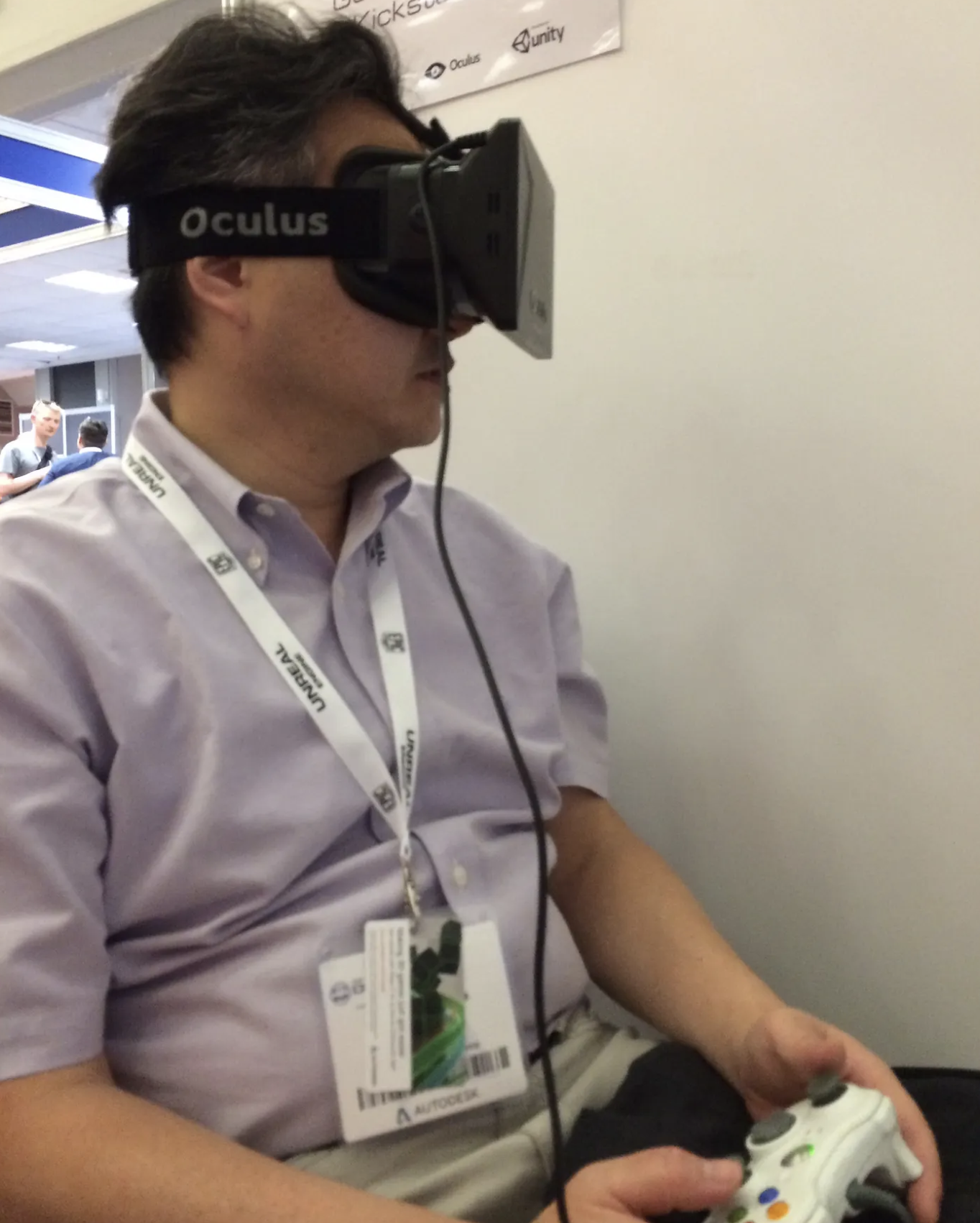
Shuhei Yoshida, then President of Worldwide Studios, PlayStation wearing Oculus Rift DK1, holding an Xbox controller, playing an early build of Radial-G at Develop Conference Expo, Brighton, 2014
I’ve covered my VR years extensively elsewhere but this was the first real project that became a (gaming) product, for the 4th wave of this immersive technology thrust back into the the limelight in 2014.
However I will make it very clear that the majority of the design and development of what became “Radial-G : Racing Revolved” was very much the work of Geoff, Michalis and Dave respectively and I only had a small hand in the overall shaping of, but ultimately the delivery and promotion of the game title, ahead of its Day One Launch Title debut in March 2016.
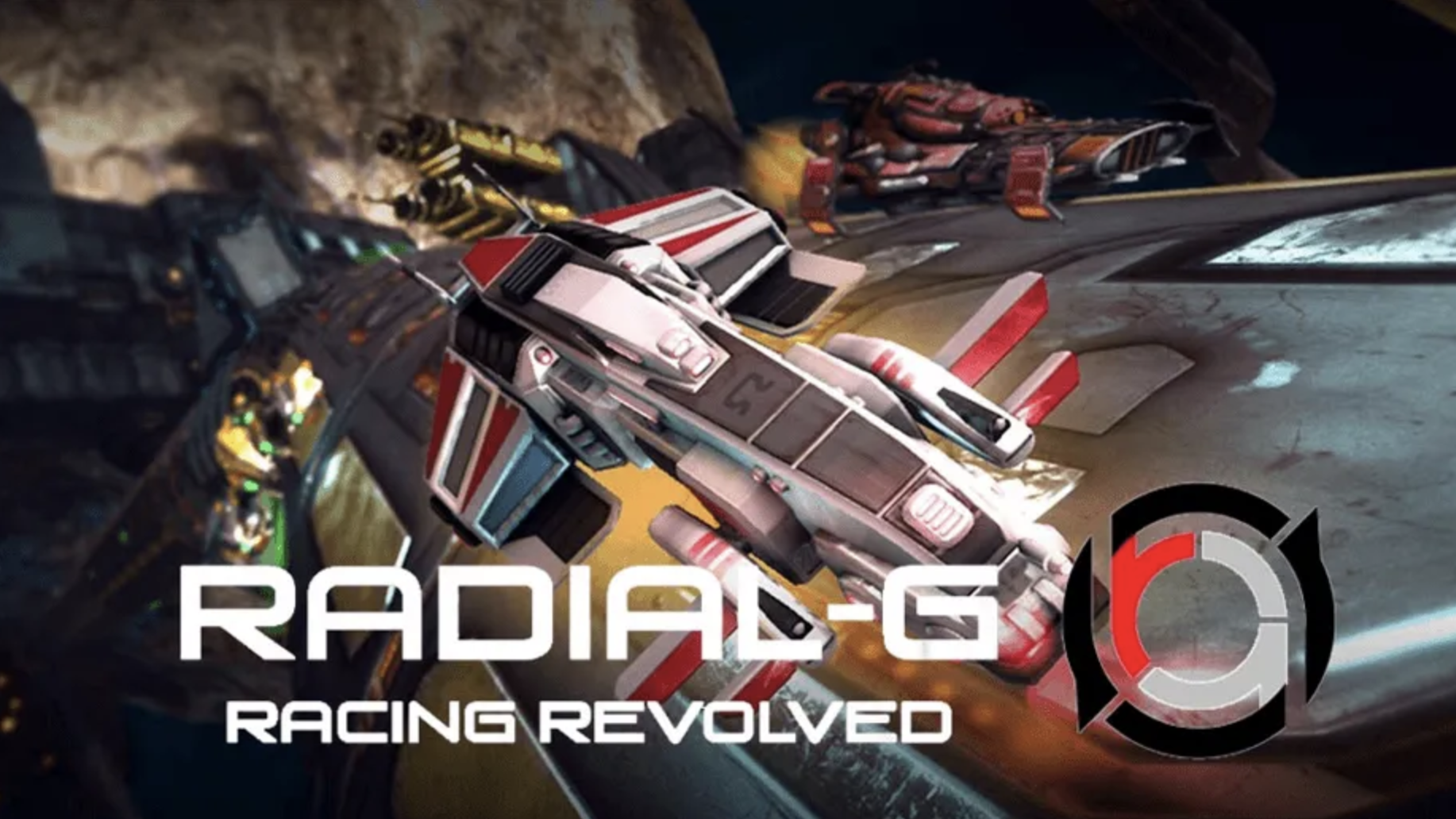
The digital store title and header image used for Radial-G : Racing Revolved
The one aspect I did suggest / design is the coloured rings around the track that represent the position of the other racers; since the track is a tube (mostly) that players race along the outer side of, if a player was out of view then it was near impossible to know where they were in relation to you.
As a game made more thoroughly fleshed out from an event booth attractor installation experience, through the early years of VR when game engine support, SDKs and prototype hardware were rough, to release on Oculus Rift, SteamVR and PlayStationVR (& and later Oculus/Meta Quest albeit development unrelated to the original studio), I remain proud of what it achieved with a small team and pennies for budget.
“Loco Dojo”
Off the success of first, the studio was fortunate enough to sign a funding deal with Oculus Publishing team for the development of the second VR game, “Loco Dojo”, designed to showcase the newly announced Oculus Touch tracked input controllers.
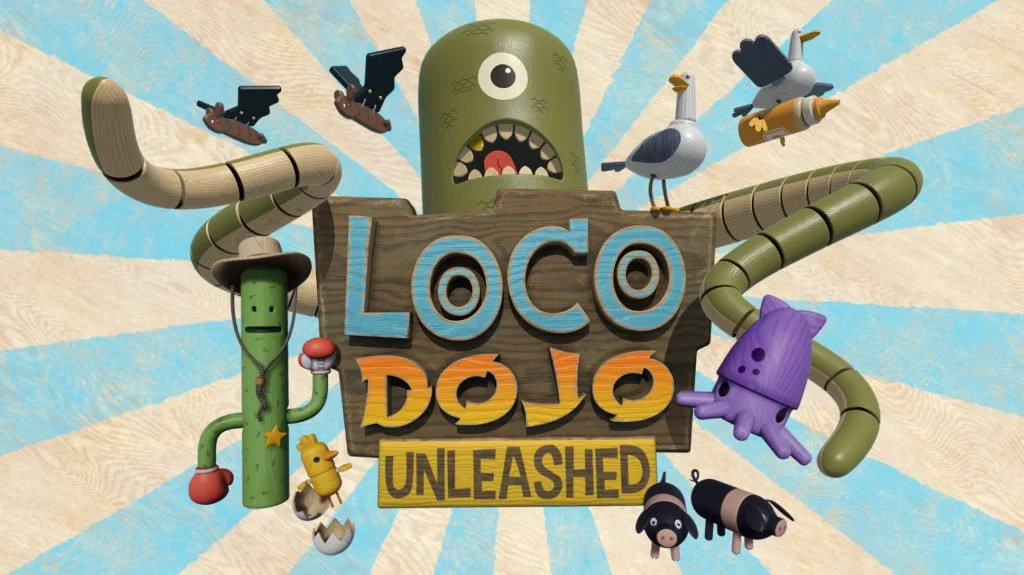
The reworked Loco Dojo Unleashed title and header images used in the Quest storefront
Once again I claim no direct design ownership of the initial game overall, this time this merit goes to Pete (Newing) who’s brain provided 99% of the mad-cap gameplay ideas, concepts and final iterations. However the minigame design process was collaborative across the studio with initial two-word ideas being voted to prototype, again to alpha, beta and final iteration etc.
However I will take credit for the “minor feature update”, added shortly post-launch after some more extensive playtesting and user feedback. We quickly realised that shorter players (i.e. kids) were struggling to reach aspects of the metagame central table and sometimes in specific minigames. This is down to the sensors in the VR HMD conveying its real world position in space, so if it was being worn by a shorter user, then this was reflected in the viewpoint in the virtual experience. Therefore a solution was required!
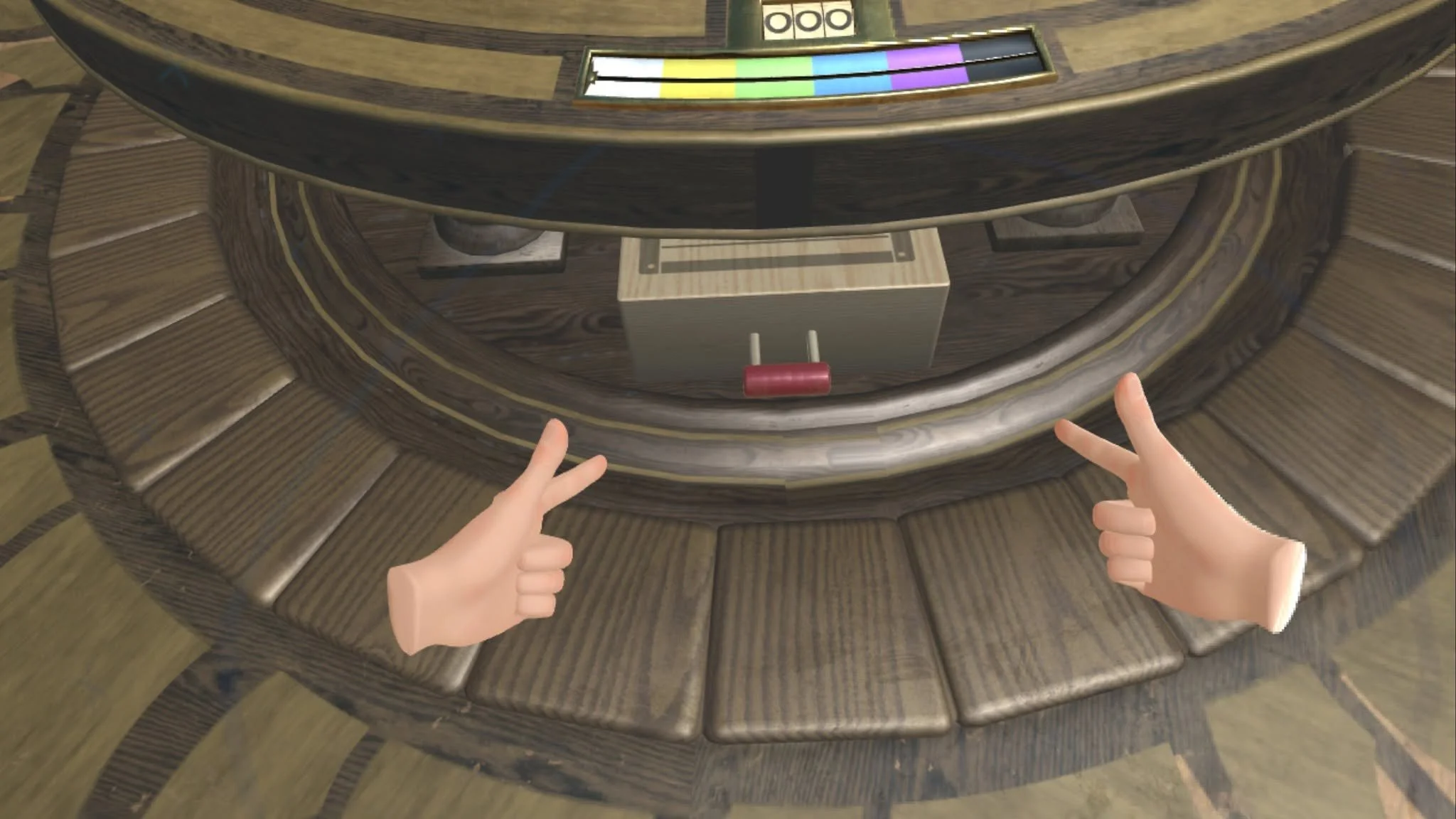
The virtual wooden box hidden under the metagame central table.
Note that this was added before any accessibility or virtual height boost features were embedded into the Horizon OS of Oculus PC VR / Quest platforms so we had to devise our own. My idea was to keep it related to the game world physicality and skeuomorphism and so we created a wooden box with a pull-handle hidden underneath the metagame table, generally only visible to those who were of short enough stature to see it. Upon pulling the handle on the box, it would pop out and be positioned under the player and allowed them to virtually stand on it to boost themselves up to the height of an average adult.
Post-launch in 2017, when the game was being revisited, optimised and prepared for launch on the Oculus/Meta Quest 2, a number of gameplay modes and enhancements were required to be greenlit for release, beyond just being a straight port, as per Oculus Publishing teams requirements for selection.
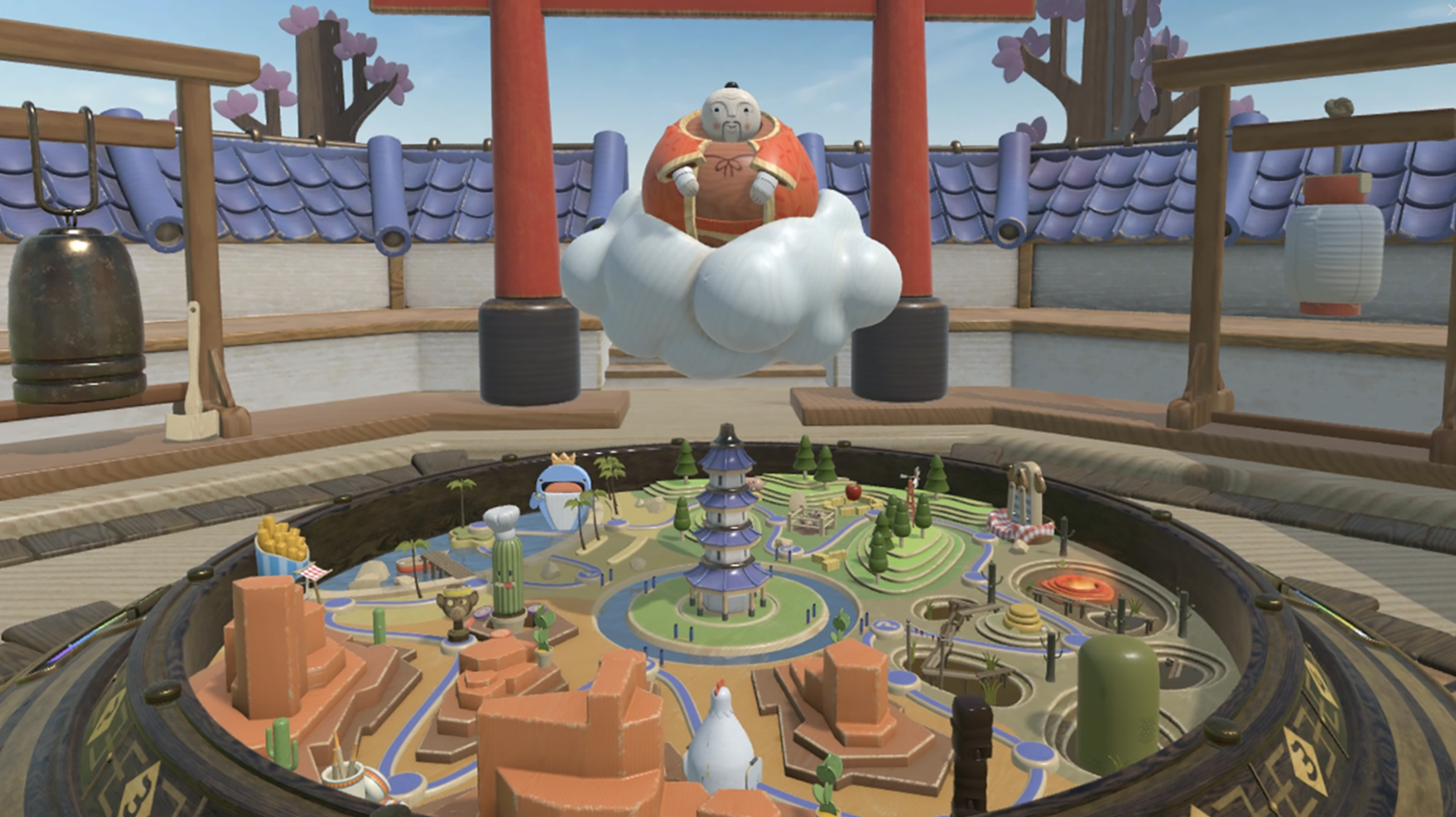
In-game screenshot showing the meta boardgame table with the Grand Sensei character, voiced by Brian Blessed, floating over it
By then Pete had moved onto another studio and so I took up the mantle of designing the new features, gameplay modes and unlocks to bolster the experience worthy of “Loco Dojo Unleashed” on Quest.
Feedback from the original launch included issues around finding other players to play against and a lack of single player content (the game was signed-off to be multiplayer first) so much of the additional design focused on these areas for the updated release.
A ‘Quick Match’ mode was added to throw players into a joinable pre-game metagame table lobby rather than the more traditional game hosting UI lobby where other players could be invited to etc. Trickier to design the user flow of was the Pass’n’Play mode, where a number of local players could play against each other in the same space using one headset, passing it between them between turns on a minigame each.
The game already had a number of animal masks that could be unlocked and selected by players to represent themselves in-game, based upon the Chinese zodiac signs. With the popularity of Squid Game rising, a single player mode ‘Solo Dojo’ was added, where acing all minigames with a gold trophy score unlocked a gold animal mask variant, to really show-off player skill.
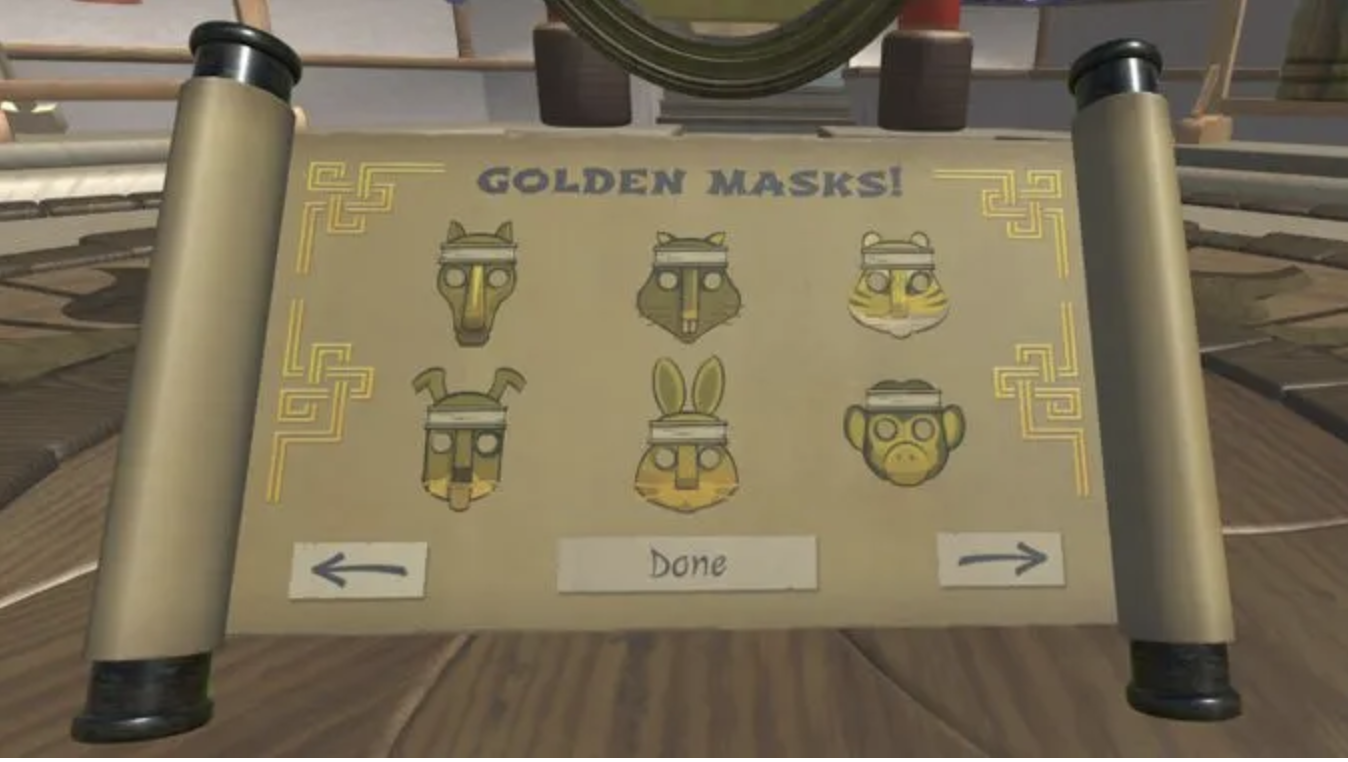
Screen capture of in-game menu showing unlocked golden animal masks
I had designed an alternative charasmatic game host for the training modes, a US, hotdog-based cousin to the original Grand Sensei, but when we managed to get Brian Blessed back into the VO booth to record new lines, this idea was no longer necessary and scrapped. The thinking here was that the US region was the largest sales market…
From prototype minigame ideas to features and reacting to market forces, one thing about design is that not everything will make it to the table *sic and it’s important to not be too precious about some ideas and know when to let go.
Websites
Thought I should include website design in this ramble as having moved to a smaller UK-focused team from much larger EU-centric MMO studios, websites were needed for the two free-to-play East > West games I was working on supporting at the time for Gamania.
Unfortuantely I didn’t take any screenshots for my records at the time and neither the games nor their associated websites are live anymore but I always give myself a chuckle recalling how I managed to get “Capture Our Souls Online!” into some PR and banner artwork.
On a more mature theme, I did update and maintain the Make Real website over many years, once the initial design work had been approved and put into place with a typical Wordpress backend to manage everything. Whilst the design has been refreshed since my departure a few years ago, much of my original content is still there.
Unity AR-chitecture Mobile App
Long before I was Senior Partner Relations Manager for Unity Technologies (2023–2026), I did design a teeny-tiny little mobile AR (Augmented Reality) app for Unity, via one of their marketing creative agency partners. Similarly it had a teeny-tiny budget but it was designed to complement their foray into the world of AEC (Automotive/Engineering/Construction) use cases, many years before Unity for Industry really existed and became a thing.
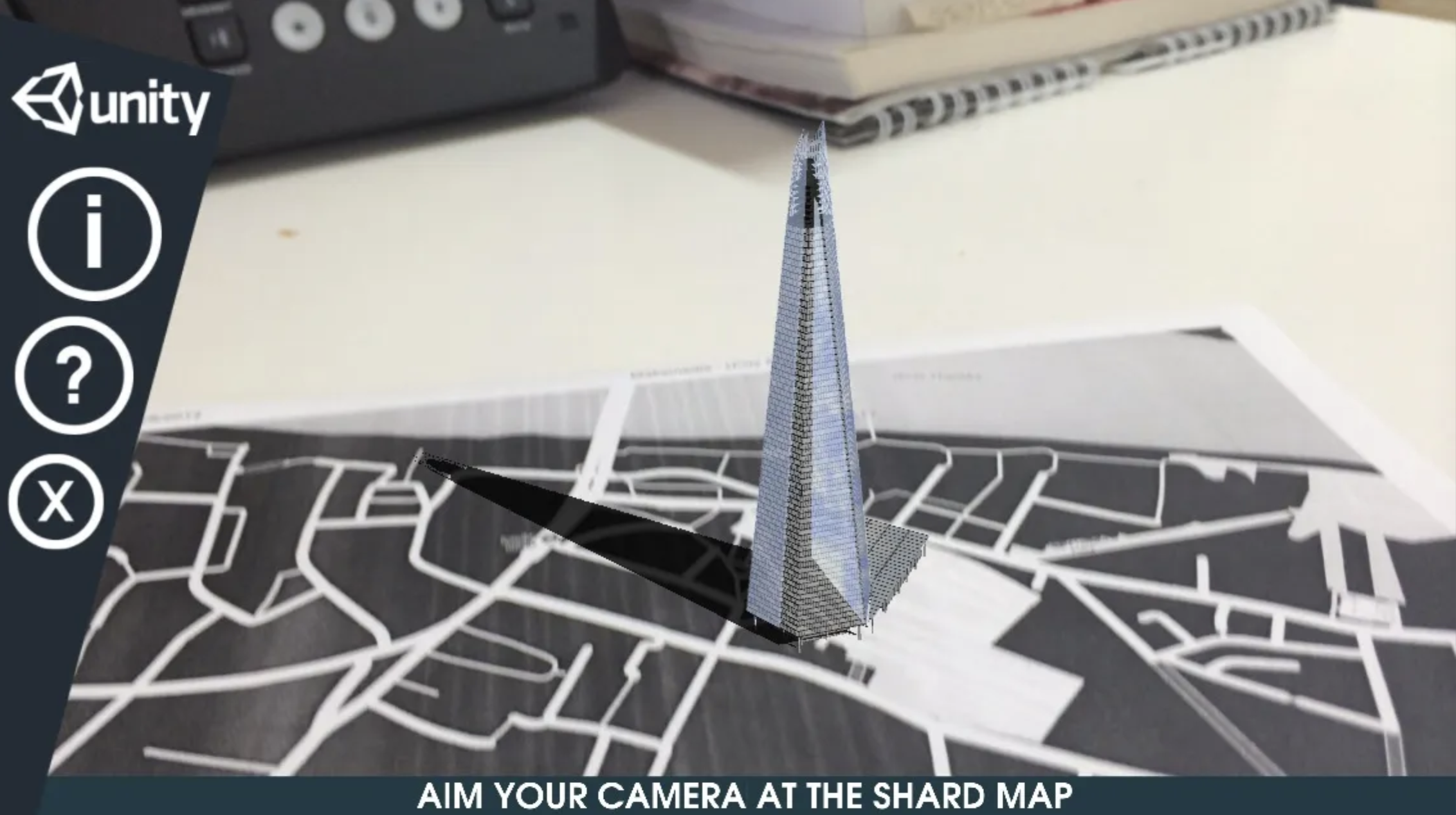
Screen capture of the iOS app running on a phone showing the 3D AR model of London Shard appearing
Scanning the map glued into the back of branded moleskin diaries given out at industry events would trigger an AR experience based around The Shard, London, built with Unity of course for Android and iOS.
“Council Clash — Town Tag-a-Loo”
Many years ago when my wife and I moved out of Brighton to a quieter town nearby, being two DINKs of a certain age it was hard to meet new people. I setup a local board gaming group, a pastime that’s another passion of mine, and many years later, regularly meetup with 15–20 people fortnightly to play card, trick, Euro and Ameritrash games.
As is the way with board game groups, some members will naturally lean towards design and create their own games, some successfully KickStarted like Huff No More’s “Sakana Stack”, whilst others are still refining for their funding opportunity.
During COVID and lockdowns, or rather when they were temporarily lifted and I was allowed to go to the pub for a couple of beers socially distanced, the walk home became the inspiration for my own board game concept.
Some local residents take it upon themselves to paint over graffiti but always with a close but never idendical or matching shade of paint, based upon whatever is leftover or to-hand no doubt. Over the years, this has created a patchwork of colours and shades and specifically on my walk back home then, on the wall next to the public toilets. This became the inspiration for my board game concept about territory control, “Council Clash — Town Tag-a-Loo”.
I set about prototyping and laying down the initial ruleset for CCTTL, stocking up on thick card paper, transparent grids and rudementary skills to design cards, iconography and initial board game pieces for playtesting.
Player cards in their hand have a variety of shapes on them that equate to pieces that can be played on their turn, covering more or less of the board with areas of paint. Paint pieces can overlap each other so players can claim areas from one another, and back again over the course of the game.
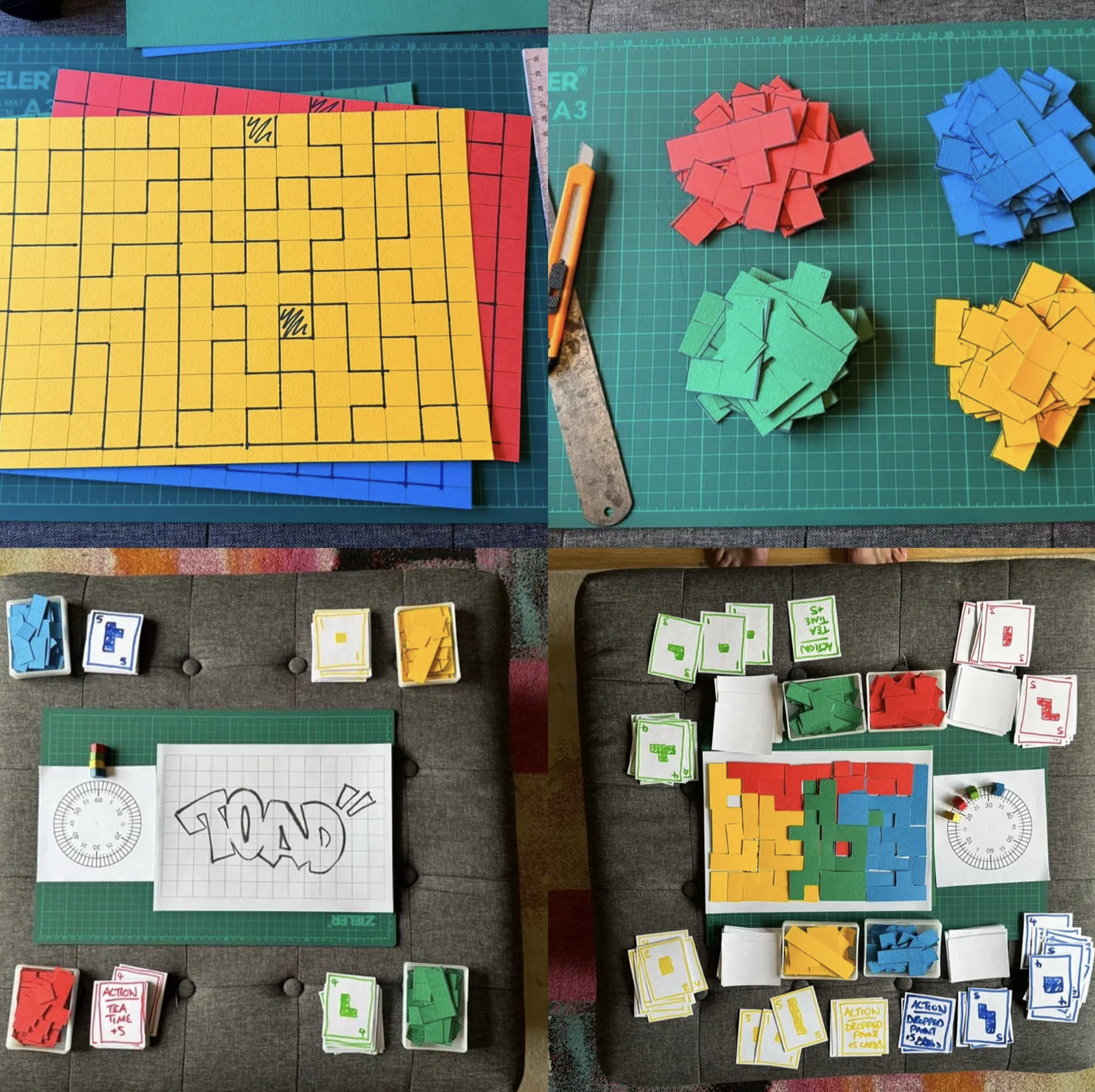
From drawing out to cutting out and finally play-testing paper prototype of CCTTL
Playtesting highlighted a core issue, even with thick paper card pieces, that after a few layers on the board, the thickness of the stack in that area become unstable and the pieces move and slide off each other. Looking further ahead to if/as/when the game should go into production with materials that are more durable and longer lasting, i.e. thicker, this issue was only going to compound and get worse.
I changed from paper card layers to 2x2x2cm wooden cubes (at great expense due to limited options for this specific size to match the game board grid spacing) which alleviated this issue but then changed the whole feel of the game. Players no longer felt like they were placing or laying tracks of paint down and stacking over or replacing another player’s cube didn’t really work thematically.
However the cubes and the new player game board interaction could make for a great new game idea, something around shipping containers maybe…
U.N.I.T.Y
Whilst I was still employed at Unity Technologies as Senior Partner Relations Manager (2023–26), I designed a card-based Serious Game to play as part of one of the EMEA team onsite workshops.
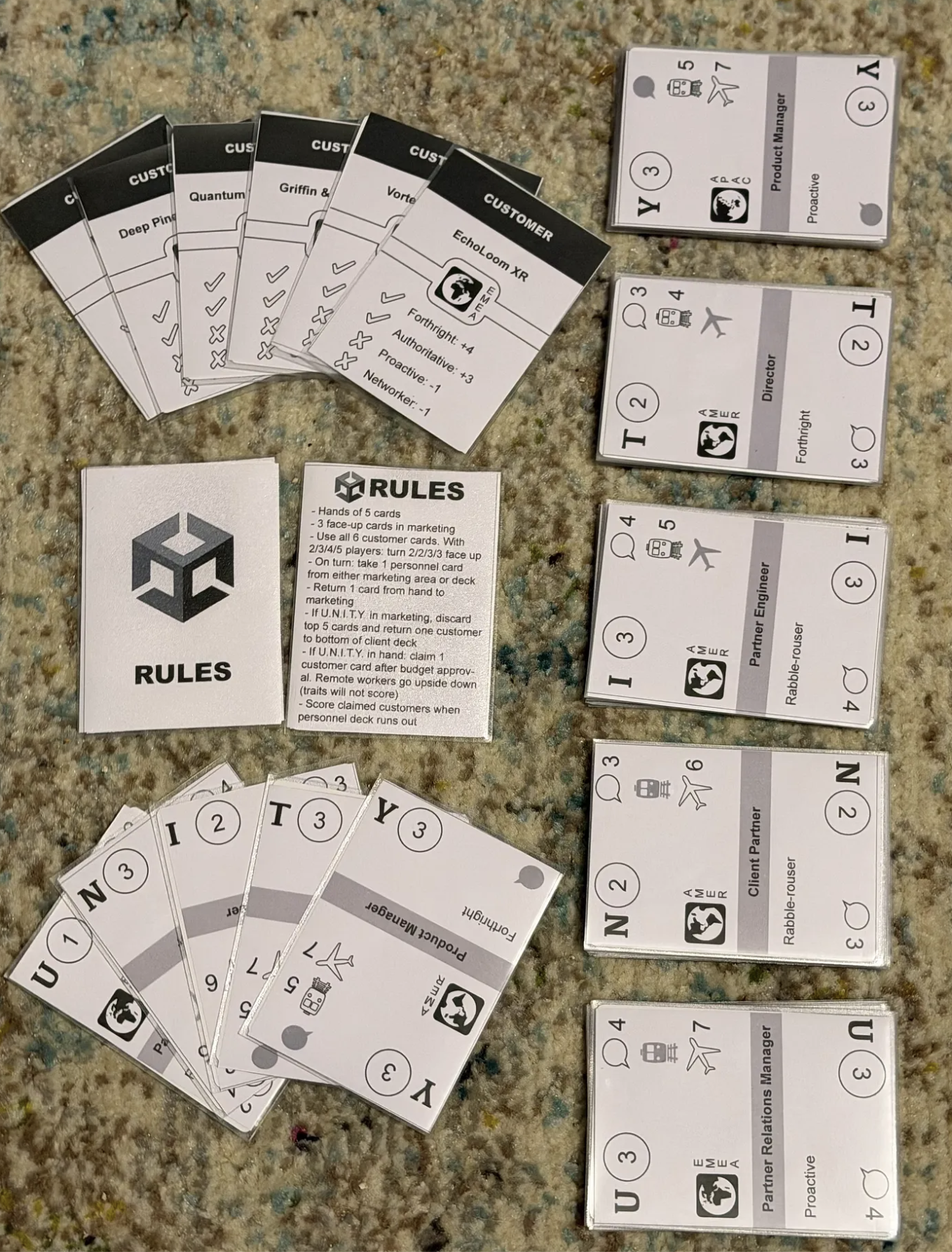
Photo of the finished sleeved player cards, rules and customer cards
The idea being each player was putting a customer-sponsored Dev[eloper] Day together with a line-up of speakers from Unity, each with their own boons, perks and buffs, location, travel preferences, cost and appropriate score value.
Once a player had collected / swapped cards in their hand to spell U.N.I.T.Y, they could claim a customer and score them accordingly. The challenge was to do this before the central pool, i.e. marketing, did the same.
As a regular additional responsibility of the team in the real world, it was a fun way to make people think about the criteria and challenges around putting such events together.
DIY
Now that digital accounts for 95% of video games revenues and with the demise of physical, moving from paper prototype to much thicker paper, i.e wood, has been a lot of fun this year as I have some time on my hands.
Starting off with something simple, I needed to create a false wall bracket to attach our very specifically chosen Klarstein kitchen bin to, in order to fit in the space typically used for washing machines.
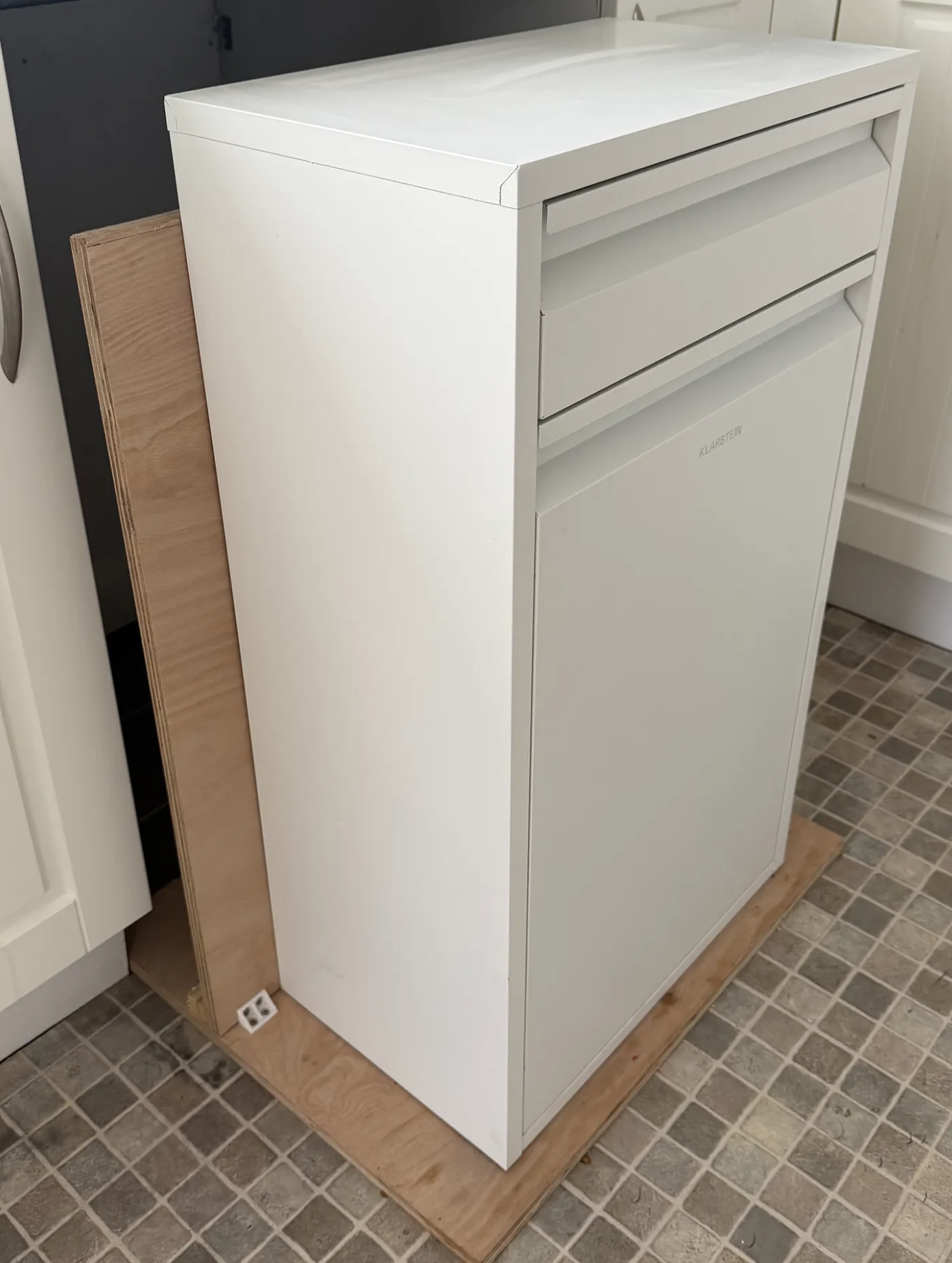
Photo of the false wood wall with the kitchen bin attached to it to stop it tilting over when opened
Moving up a grade, I cheated somewhat but still had to assemble the garden kitchen BBQ table for my newly acquired Kamado Joe, to smoke all the meats with.
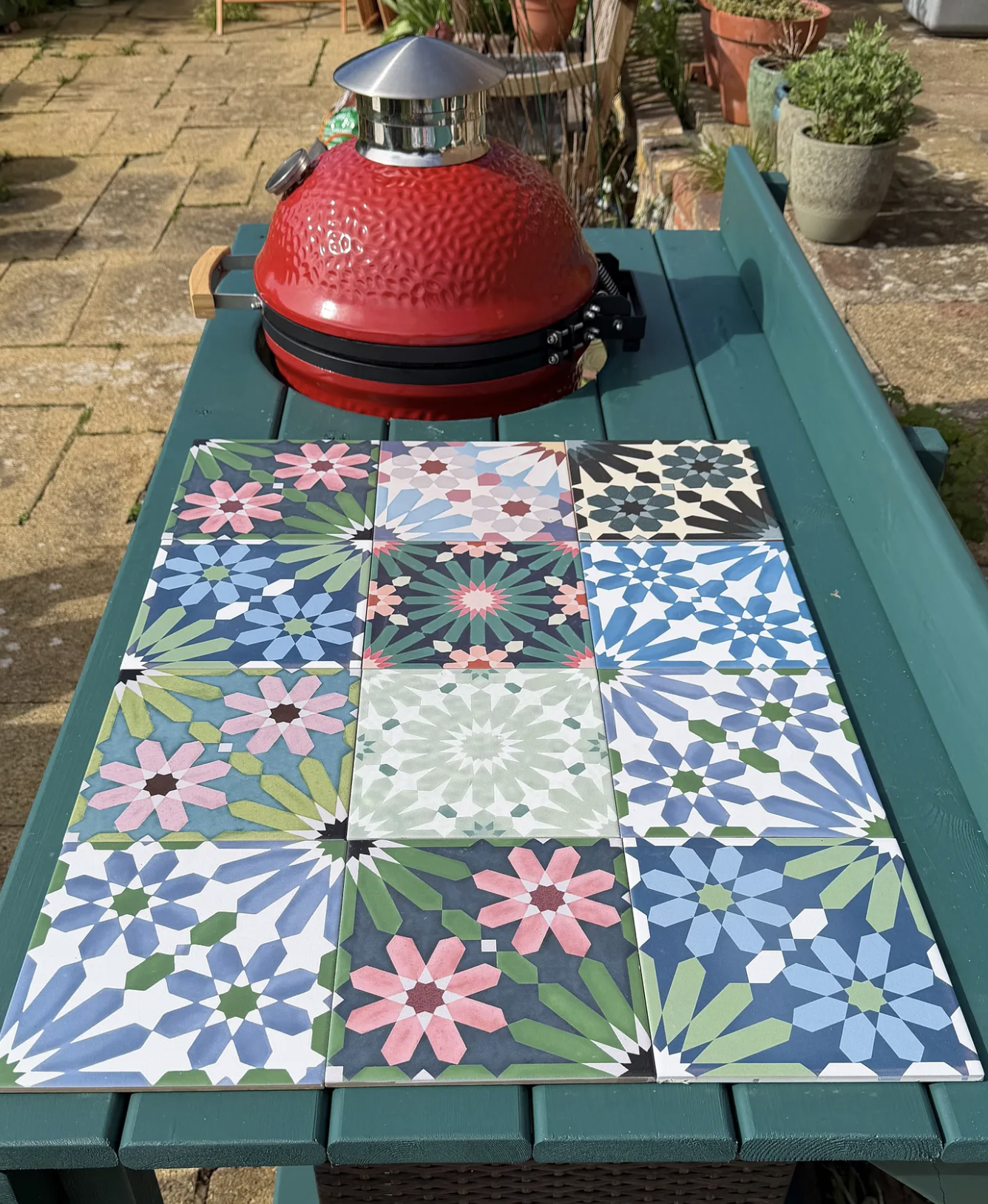
Photo of the assembled garden kitchen BBQ table with a selection of patterned tiles for the food prep / pizza oven area
Still cheating with an online restoration kit, the garden chairs and bench still took some work to complete in order to make them useable once more.
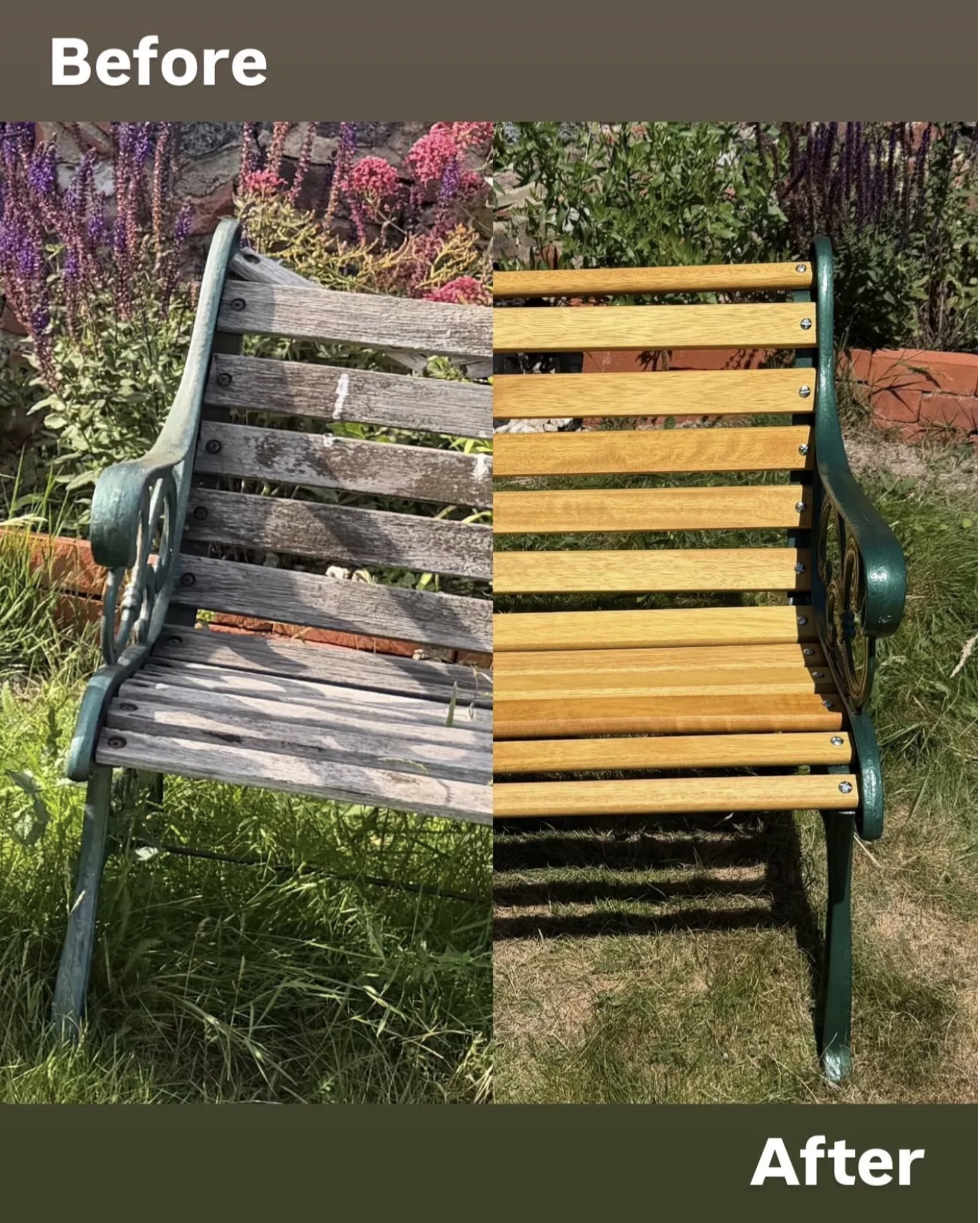
Side-by-side photos of before and after the restoration of the garden furniture
Something that actually needed designing were some steps to go from patio to the rear raised area where the water tap is located, in order to make transitioning between the two easier for us, and the mother-in-law when we go away and the plants need looking after.
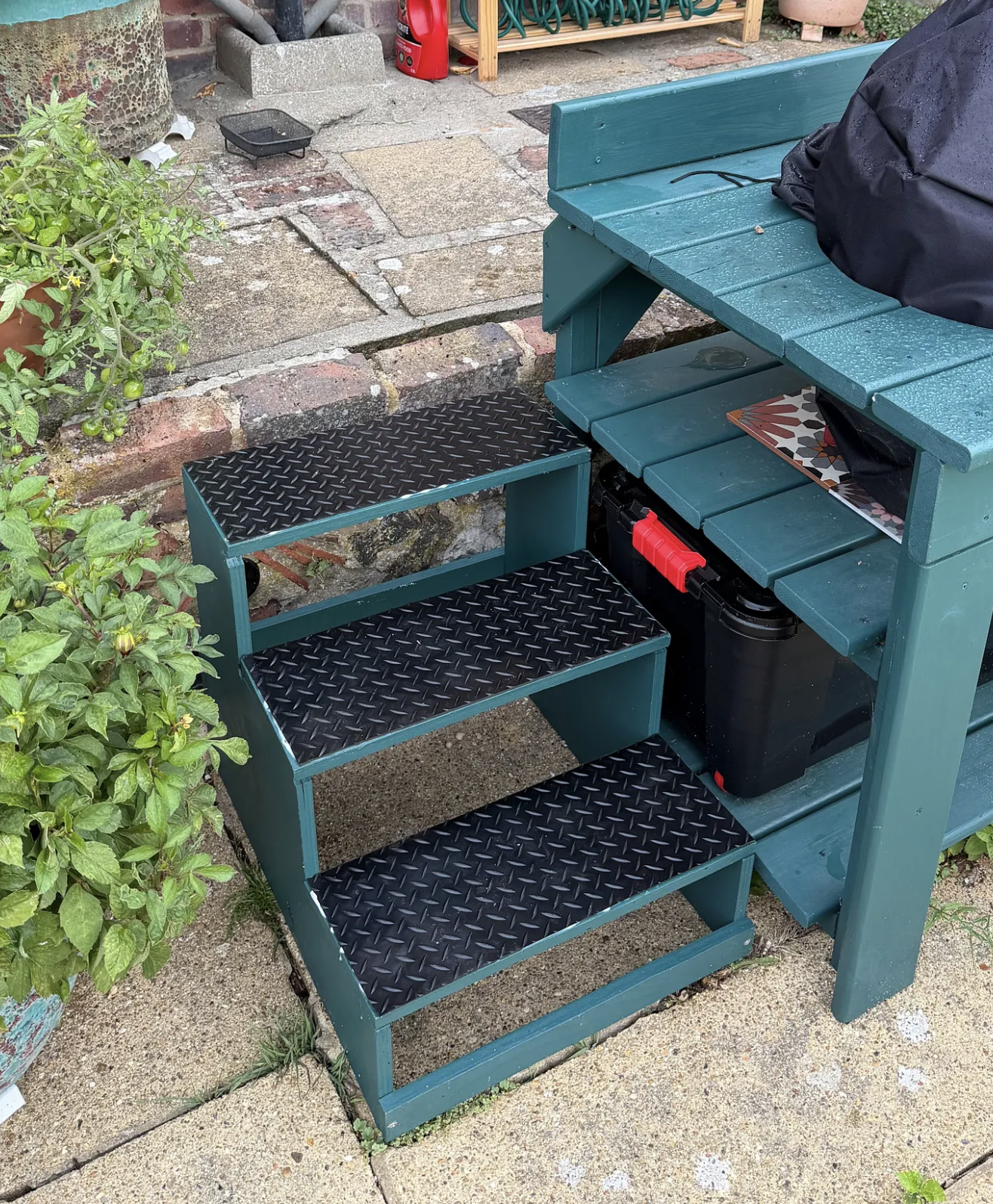
Photo showing the finished steps in place next to the garden kitchen BBQ table
With that under my belt, and whilst it is mostly finished, and admittedly not so exciting as a bench or a BBQ table, the bin store is coming together to allow the bins to be hidden from sight and provide another area for flowers to be grown on… even with a minor error.
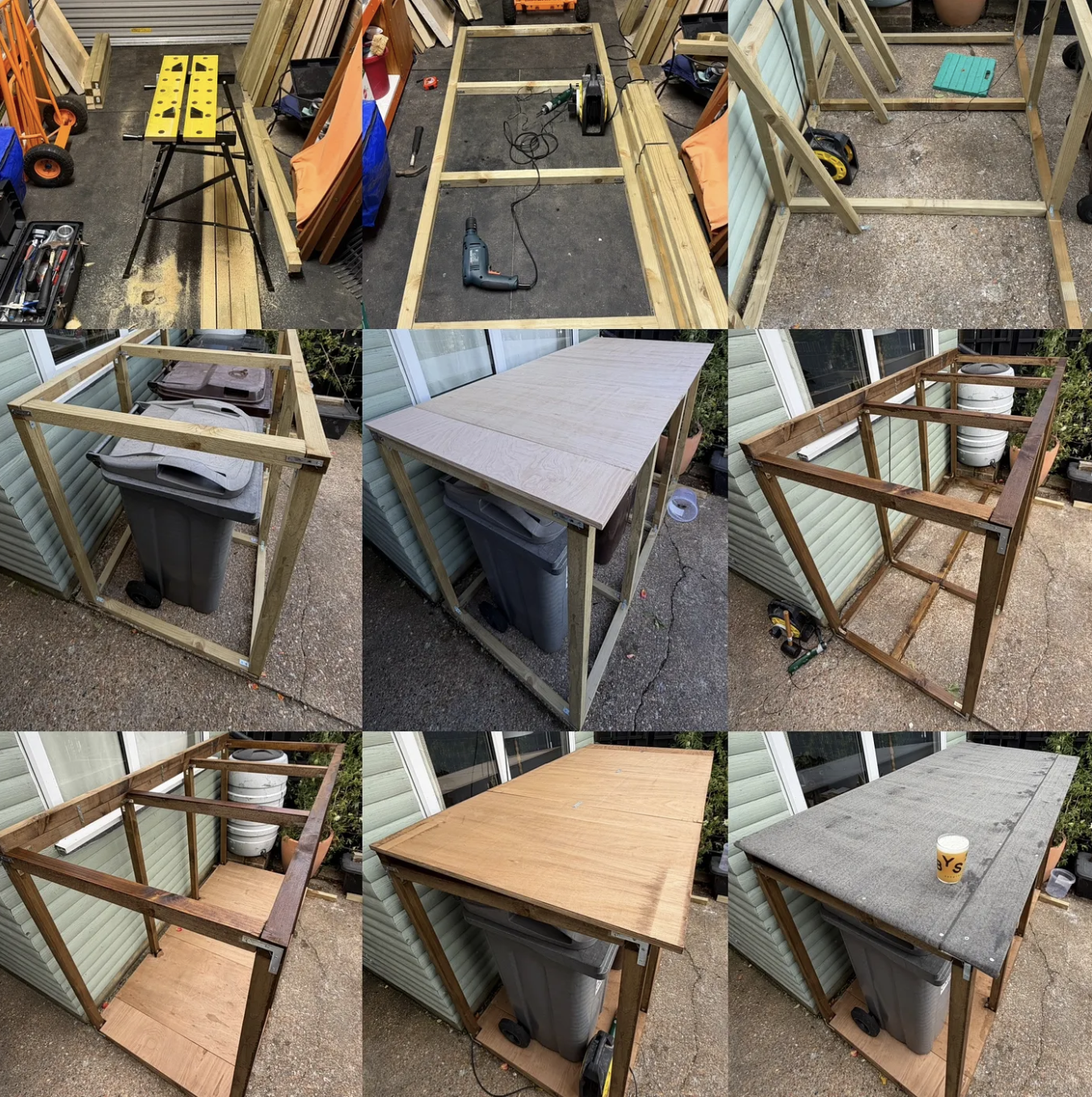
9-grid photo array showing stages of DIY development of the bin store
Design comes in many shapes and forms for a range of purposes. Over the years I have enjoyed expanding my skillset into new avenues that I previously hadn’t anticipated or thought about. This is similar for game development, especially when working as a solo-dev or for a small indie studio - many roles are rolled into one required a range of skills and abilities, only requiring specialisation as the organisation grows alongside the team size.
Where this takes me in the future, we will have to wait and see but if you are looking for a multi-faceted wearer of many hats, get in touch!